
Decoding Uniqlo’s Sustainability Strategy
- Moulishree Srivastava
- Jun 19, 2024
- 10 min read
Updated: Jan 8

Just recently, Uniqlo made a buzz about something fluffy—it collaborated with the globally popular anime One Piece, to celebrate its 25th anniversary.
As a part of its collaboration-cum-celebration, the Japanese fast fashion retailer has come out with a Uniqlo T-shirt line that captures dramatic moments of the One Piece storyline in eight designs. Clearly, tapping the huge fan following of the iconic anime across the globe is something Uniqlo is happy doing.
Beyond the buzz, Uniqlo also announced releasing three new designs under its Peace for All project. The profit from the sales will be donated to global peace projects run by the UN refugee agency and Save the Children. Over four million Peace for All T-shirts have been sold since the project's launch in June 2022, with the total amount of donations from sales crossing 1.2 billion yen.
While this may seem like a gimmick to enhance the brand image, it’s a part of Uniqlo’s expansive and well-thought-through sustainability strategy. In fact, in 2011, Fast Retailing, the parent company of Uniqlo, became the first Asian company to sign a global partnership with UNHCR to support refugees and internally displaced people with monetary assistance, clothing, and employment opportunities.
Over time, the company has evolved its sustainability strategy, championing social and environmental causes, knowing fully well how deeply they are connected to the brand's image and ultimately sales.
A Quick Look At The Uniqlo Empire
Uniqlo is a Japanese fast fashion retail brand with a strong global presence, focused on design innovation, quality, and affordability.
Origin: The roots of Uniqlo trace back to Ogori Shoji, a men's tailoring shop in Yamaguchi, Japan, founded by Hitoshi Yanai in 1949. Three and a half decades later, Hitoshi Yanai’s son Tadashi Yanai, who inherited his father’s chain of 22 men’s tailoring stores, opened a unisex casual wear store in Hiroshima called Unique Clothing Warehouse in 1984. This later became Uniqlo.
Uniqlo was set up as a subsidiary of Ogori Shoji, which changed its name to Fast Retailing Co. a few years before listing on the Hiroshima Stock Exchange in July 1994.
Growth: In the 1990s, Uniqlo expanded throughout Japan, opening multiple stores and introducing its private-label clothing. A decade later, it ventured into international markets, launching stores in major global cities like London, New York, Paris, and Shanghai.
Uniqlo, which started as a single store on a shopping street in a coal-mining community in Hiroshima, now operates over 2,400 stores across Japan, Asia, Europe, and North America as of 2024. It’s one of the world's largest apparel retailers with 2.7 trillion yen (approx US$17 billion) in annual sales last year.
The Rise & Rise of Uniqlo
How did Uniqlo rise to become one of the biggest fashion retailers, competing with the likes of H&M and Zara? Long years in operation did help, but the winning formula involves a combination of factors.
Product Philosophy: “Life Wear” is Uniqlo’s core philosophy, which means creating high-quality and functional clothing at affordable prices that last long. Not what fast fashion guys would normally want their customers to do. On top of that, it’s a fashion brand that doesn’t follow fleeting fashion trends but focuses on versatile, universal, and timeless casualwear designs. This ideology has actually helped it gain a loyal customer base globally.
Focus on R&D and tech: Why does a fashion brand need to do R&D? Well, Uniqlo gets its differentiation from the innovative fabric it uses. Over the years, it has developed radical new materials together with leading fabric and technology innovators like Toray Industries.
For instance, it has invested heavily in developing signature technologies like HeatTech for warmth and AIRism for breathability as well as Ultra Light Down and Pufftech for lightweight winter wear.
Business Model: Uniqlo’s business model is ingeniously simple. Be in control of the entire process. The company operates on the SPA (specialty store retailer of private retail apparel) model, controlling the entire process from planning, design, and production to distribution and sales. This allows Uniqlo to have greater control over quality, cost, and efficiency. At the same time, it helps the brand minimize waste and reduce environmental impact.


Notable mentions: Other factors that have made Uniqlo grow gloriously through the years include tapping online commerce in time, its sustainability initiatives like recycling and reducing waste, and its customer-centric culture that incorporates customer feedback into product development.
Why Is Fast Fashion Under Fire?
Fast fashion retailers usually draw a lot of flak for causing deep-rooted social and environmental impact, and rightly so. Uniqlo is no different. The brand has been under the watchful eyes of conscious consumers and sustainability enthusiasts.
Let’s look at the kind of challenges a fast fashion retailer deals with, while receiving a truckload of hatred for it.
Environmental Challenges
Overproduction and Waste: The fast fashion model relies on rapid production cycles and high volumes, leading to overproduction and excess inventory. Unsold clothes either end up in landfills or incinerated, leading to toxic textile waste and major carbon emissions.
Carbon Footprint: Fast fashion retailers, particularly those with global supply chains, generate significant carbon footprints throughout their entire product lifecycle, from energy-intensive production to widespread transportation and logistics.
Water Usage and Pollution: It takes about 2,700 litres of water to manufacture one T-shirt. The textile industry is a major consumer of water and generates a significant amount of wastewater, often containing harmful chemicals used in different stages of the production process. These can include dyes and pigments, heavy metals, and surfactants.
Social Challenges
Labor Rights Concerns: Fast fashion retailers including Uniqlo often face criticism regarding labour conditions in their factories. The criticism is mostly around low wages, long working hours, and unsafe working environments.
Supply Chain Transparency: A fast fashion company’s supply chain is vast and complex, which makes it difficult to trace the origins of materials and ensure ethical sourcing.
Animal Welfare: The use of animal-derived materials, such as wool, leather, and down, (the industry parlance for light feather) raises concerns about animal welfare. Given that brands require fast sourcing, ensuring the ethical treatment of animals remains a challenge that isn’t often talked about.

Enter The Sustainability Strategy
Fast fashion giants walk on thin ice when it comes to handling environmental and social concerns effectively. Getting shunned by beloved customers—particularly millennials and Gen Z, who are more conscious and informed—is easier than getting a parking ticket.
Uniqlo is one of those fast fashion brands that have been able to incorporate sustainability into their business approach. In fact, the company’s experimentation with sustainable practices began almost two decades back.
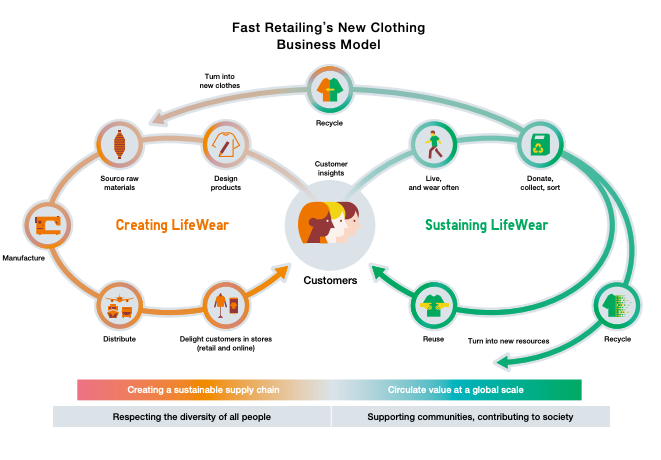
In 2006, Uniqlo launched the All-Product Recycling Initiative, thinking it would collect Uniqlo clothing that its customers no longer use and recycle them for industrial purposes. But it turned out that most of those items were in wearable condition, so it gave them a second life by delivering them directly to people in need all over the world.
By the 2010s, Uniqlo expanded its sustainability initiatives for responsible sourcing, reducing environmental impact, and increasing social responsibility. However, it was only in late 2021 that the parent company, Fast Retailing reimagined its LifeWear concept and embraced circularity. It set targets to reduce greenhouse gas emissions by FY 2030, as per the Paris Agreement.
Its FY 2030 sustainability targets have been approved as Science-Based Targets by the SBTi (Science-Based Targets Initiative).
Here is a peek at its current multi-faceted sustainability strategy:
Recycling and Upcycling
Uniqlo has formalised its recycling initiatives by launching the Re.Uniqlo framework in 2020 to promote circularity in the fashion industry.
The ideology behind this framework? Reduce clothing disposal by extending the lifespan of each garment. Reuse clothing for a new purpose. And recycle used clothing into new products and materials.
Re.Uniqlo released Recycled Down Jackets as the first offering from the initiative, which used down extracted from 620,000 second-hand jackets as the insulating filling. This represented Uniqlo's first product-to-product recycling project.
Moreover, Re.Uniqlo promotes clothes made from recycled materials like down and plastic bottles. For example, it uses recycled polyester made from post-consumer PET bottles for its products like polo shirts and fluffy yarn fleece.
The company also set up a Re.Uniqlo Studios aka Second Life Studio as a trial at one of its stores in Germany in August 2021, offering a clothing repair service in cooperation with an NGO. By October 2023, the company opened these studios in 16 markets worldwide, including 20 in Asia.
Customers can get their favourite clothes repaired or remade into fresh items at a Re.Uniqlo Studio. They can also bring in their used Uniqlo clothing to be recycled into new products or donated to people in need.
Responsible Sourcing
Uniqlo wants to source materials responsibly, and that entails a lot of things.
Things like prioritising sustainable cotton and recycled materials, adopting a procurement process that promotes carbon footprint and water usage reduction, and respecting human rights and animal welfare.
To that end, the company only uses responsibly sourced down and feathers from farms that minimise their impact on wildfowl. Moreover, to source sustainable cotton—cotton grown with less water, pesticides, and chemical fertilisers—it joined the Better Cotton Initiative (BCI) in 2018. BCI educates cotton farmers on the proper use of water, pesticides, and other agricultural chemicals as well as on workers’ rights.
Uniqlo aims to procure 100% cotton from sustainable sources by the end of December 2025. Overall, the company wants to switch 50% of all materials it uses to recycled and other low GHG materials by FY2030 from 8.5% in FY 2023.
On the human rights front, Fast Retailing follows responsible purchasing guidelines. For example, when placing an order, it develops a purchase plan based on the production equipment and capacity of the factory. The quantity and delivery dates are agreed in advance and no changes can be made without factory consent.
Reducing Environmental Impact
By FY2030, the company aims to slash operational emissions by 90% and its supply chain emissions by 20% compared to FY2019 levels. The company wants to achieve the former through a combination of energy conservation efforts at stores, a transition to 100% renewable electricity for all Fast Retailing stores and offices, and the development of innovative, energy-efficient store designs. The latter, meanwhile, is harder to fulfil.
It is working with partner factories in phasing out coal and using renewable energy, but the transition is likely to take time due to capital investment and other factors.
Additionally, Uniqlo wants to cut down per-unit water usage by 10% (vs. 2020 levels) at each of the major garment factories and fabric mills that together account for 80% of the water used for its products.
Zero Waste
Uniqlo is aiming to have zero per cent discharge of harmful chemicals from its products and production processes at sewing and fabric factories by FY203o. Furthermore, to help achieve zero operational waste, it has stopped using single-use plastics and shifted to environmentally friendly paper bags.
It also recycles product packaging, cardboard during shipping, plastic bags, hangers, etc. Overall, Uniqlo implements the Zero Waste concept by reducing, replacing, reusing, and recycling materials used in the process of delivering clothes to customers.
Transparency and Traceability in Supply Chain
Fast Retailing has a three-pronged approach to reforming its utterly complex global supply chain—map the supply chain and consolidate partners, diversify production bases, and establish traceability by understanding the commercial flow from raw material to garment factories.
In July 2021, the company formed a global project team of about 100 people to trace the whole supply chain, from upstream spinning mills to the raw material level. Their responsibility includes identifying issues across the supply chain relating to human rights, working conditions, and the environment. They do this through site visits, audits by third-party organisations, and third-party certifications.
Parallelly, beginning in 2023, Uniqlo has started providing information online on its products about their impact on the planet and society, which may help conscious consumers make conscious decisions about their purchases.
Social Responsibility & Diversity and Inclusion
Uniqlo’s social initiatives broadly include contributing to humanitarian aid for refugees and children, providing second-hand clothing to those in need, running educational programs, and supporting employment in developing countries like Bangladesh.
For the fiscal year of 2025, Fast Retailing, the Fast Retailing Foundation, the Yanai Tadashi Foundation, and founder Tadashi Yanai, have decided to collaborate to implement social contribution activities worth 10 billion yen (US$63 million), donating 10 million items of clothing and providing support to 10 million people.
On the employment front, the company has an internal target of having 50% women in management positions throughout the group by FY 2030. The company also has policies for hiring people with disabilities as well as creating a friendly environment for LGBTQ+.

How Is It Going?
The sustainability efforts of Uniqlo over the years have borne some fruits, positioning it as a somewhat environmentally friendly company.
In 2022, Fast Retailing secured a double A score on climate change and water security from the global environmental non-profit CDP. However, concerns remain when it comes to maintaining transparency in the supply chain and ensuring fair labour practices. Let’s look at how the sustainability initiatives are working out as per the company:
Against the 90% GHG emissions reduction target in operations by FY 2030, the company has cut carbon footprints by 45.7% as of FY 2022.
It has slashed emissions by 6.2% in the supply chain against the 20% target by FY2030.
In FY2022, 42.4% of its stores and main offices used 100% renewable electricity, against the goal of 100% by FY 2030.
By FY2023, the representation of women in management positions reached 44.7%, as against the target of 50% by FY2030.
To ensure transparency in the supply chain, the company has disclosed the production partners list.
In 2022, 49% of the factories met the zero discharge of harmful chemicals targets.
While monitoring the working environment at partner garment factories, the company found and resolved 14 zero-tolerance issues like child labour, forced labour, oppression and harassment, discrimination, and failure to pay wages, among other things, in FY2023.
Uniqlo has disclosed its environment and social data verified by third parties.
Embracing a comprehensive sustainability strategy can be a daunting task for any brand.
After all, there are multiple broad time, effort, and cost-consuming aspects like reducing carbon footprint and waste; adopting a circular economy with sustainable product development, recycling, upcycling, and eco-friendly packaging; promoting social contribution for communities; improving supply chain transparency and establishing traceability, and maintaining proper corporate governance.
Uniqlo seems to be on the right track, in this regard.
Like Hedwig? Subscribe to it here to get insights on the Asian startup ecosystem and building a sustainable business.
At The Content House, we offer research-based, analytical content that has a strong narrative quality to it. What makes us different in the crowded content market is our ability to convert institutional knowledge and expertise locked inside organizations into content that companies can use to increase brand reach.


Comments